There's a version of me from a few years ago who would have laughed at this whole idea.
Locked in. It's one of those phrases that got hijacked by social media before anyone bothered to define it properly. Locked in on my fitness. Locked in on my bag. Locked in on the grind. People say it with a straight face like it's obvious what it means, and maybe it is, right up until you try to apply it to something as messy and unglamorous as a corporate job. Fitness has reps you can count. A savings goal has a number you can watch grow. A career doesn't hand you that kind of clean feedback. Nobody tells you at the end of the quarter, congratulations, you were locked in.
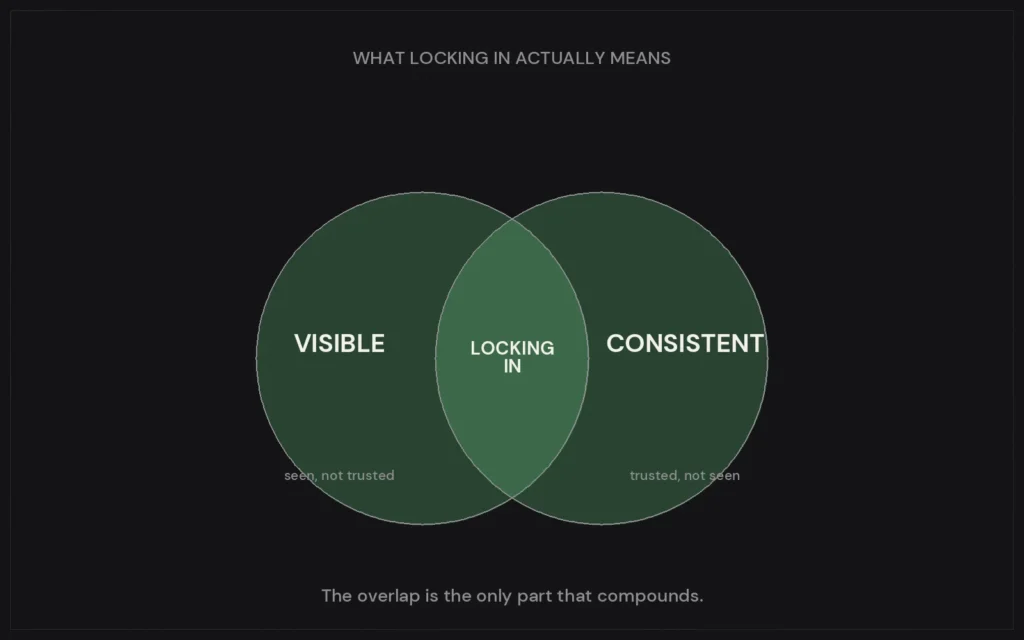
So I started asking myself what the phrase actually meant once you strip away the caption energy. And the answer I kept landing on had two parts that refused to separate from each other. You build a reputation people can actually see. And you stay consistent enough that the reputation survives contact with a bad week, a hard project, a manager who's watching closely. Miss either one and the whole thing falls apart. You can be consistent and completely invisible, grinding away at good work that nobody notices or credits. I've watched people do that for years and wonder why they never get pulled into the room where decisions happen. Or you can be visible and inconsistent, loud and impressive for a month, then gone, a flash that people remember but don't trust. Locking in, the real version of it, lives in the overlap. It's the Venn diagram middle that almost nobody talks about because it's not as fun to post about.
Let me take you back to where this actually started for me, because it didn't start with a grand plan.
The spreadsheet that turned into a game
I was deputy team lead at First Icon Group when the conversation came up about how we were tracking social media growth and performance across the brands we managed. I wasn't pulled in from the outside. I was already in the room, already part of that conversation by virtue of the role, which meant the pressure to actually solve it sat a little closer to me than it might have otherwise. The honest answer at the time was that we weren't tracking much of anything in a way that meant something. Numbers were scattered across different people's heads. People had opinions about what was working, but opinions aren't data, and data was what the MD actually wanted walking into strategy meetings.
Nobody handed me a template for this. There was no manual that said here's how you turn raw platform metrics into something a managing director can glance at and understand in ten seconds. I built it in Excel, which sounds almost too simple to matter, but the sheet itself wasn't the point. The visuals layered on top of it were. I designed it so both the MD and the staff working under the brands could look at the same numbers and immediately understand where things stood, not just in a dry, this is the engagement rate kind of way, but in a way that told a story about who was winning and who needed to catch up.
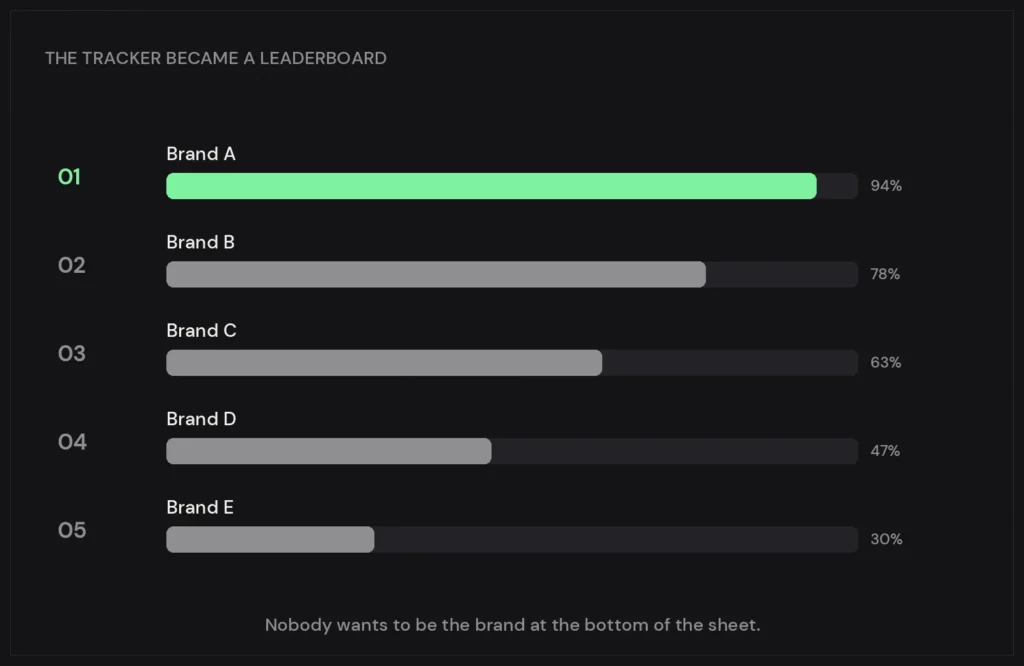
That's where it got interesting. Somewhere along the way, without me deliberately setting out to do it, the tracker turned into something closer to a game. People started checking it the way you'd check a leaderboard. Nobody wants to be the brand sitting at the bottom of the sheet when the MD is scrolling through it. That little bit of friendly competition did more for consistency across the team than any memo about performance targets ever could have. I learned something from that I didn't expect to learn from an Excel sheet: numbers move people faster when they can see themselves next to everyone else, not just next to a target.
The automation that stopped being mine
Then came the certificate of investment automation project, and this is the one that really taught me something about what it means to build things that last beyond you.
Before the automation, generating certificates of investment was a manual, repetitive process, the kind of task that eats hours and invites errors simply because humans get tired and distracted doing the same thing over and over. I built something to take that burden away. But here's the part that stuck with me. It didn't stay a personal win, something I could quietly point to on a CV and move on from. It became infrastructure. It got woven into how the team operated day to day, which meant that during handover, I found myself sitting down with a couple of staff members, walking them through the logic of it step by step, answering the same question three different ways until it clicked.
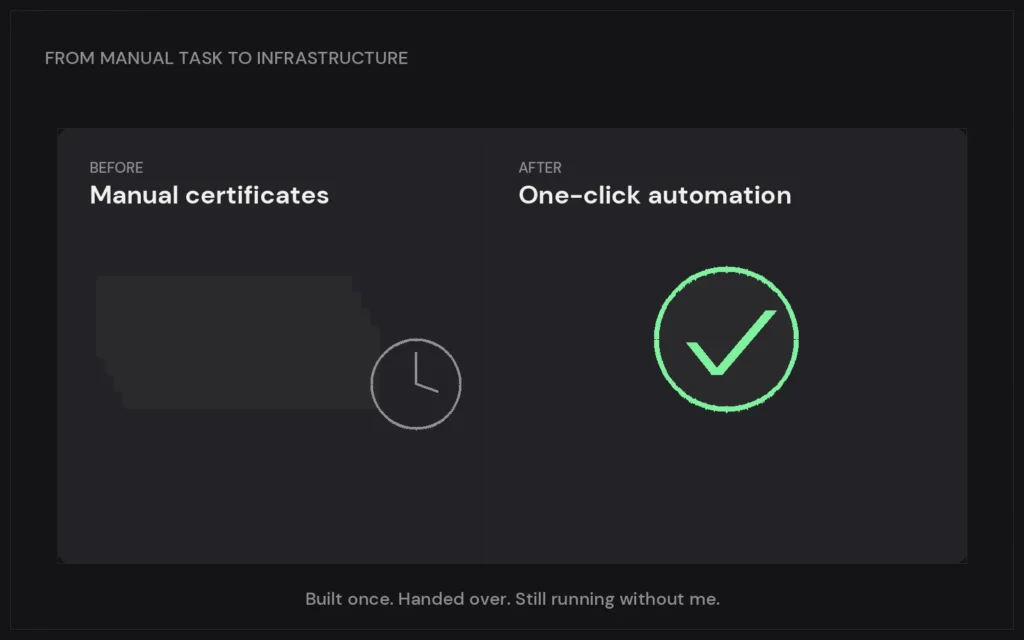
Teaching someone else to run something you built is a completely different skill from building it in the first place. It exposes every shortcut you took, every assumption you made that only made sense inside your own head. If what you built can't survive being explained to someone else, it wasn't really finished. That handover process humbled me a little, in a good way. It's one thing to be clever. It's another thing to be useful to people who didn't build the thing and don't need to understand the clever part, just the working part.
“Sunday would never allow a project to fail”
That pattern followed me when I moved into HNG, and it's where I heard a sentence that has quietly lived in my head ever since.
A colleague of mine said it almost in passing, not as some grand compliment, just an observation in the middle of a conversation about deadlines. “Sunday would never allow a project to fail.” I remember pausing on that for a second because it wasn’t about talent, not really. It wasn’t about being the person in the room who already knew every answer. Half the time I didn’t know the answer. What I had was something more stubborn than knowledge. A refusal to let a problem stay unsolved just because I hadn’t figured it out yet.
I don't need to know how to do everything walking into a task. Almost nobody does, if they're honest about it. What I can do is learn quickly, dig into documentation at midnight if I have to, troubleshoot a broken process until it stops being broken, ask the annoying question in the group chat that nobody else wants to ask because it makes them look like they're behind. That's the skill that actually travels. Tools change. Platforms change. Job titles change. That refusal to quietly let something fail does not.
Learning WordPress because the work needed it
That same instinct showed up again at my current role, in a way I didn't see coming.
Nowhere in my original job description did it say you will manage a WordPress website. But the work needed doing, the site needed pages that didn't exist yet, and there was a gap between what the brand wanted to communicate and what the website could actually show. So I learned it. Not because I had some deep passion for content management systems sitting dormant inside me, but because the alternative was watching a gap stay open and pretending it wasn't my problem. I built pages from scratch, broke a few things along the way, fixed them, and slowly the website stopped being a weak point and became one more thing I could point to.
That's the thread running through all four of these moments, if you zoom out far enough to see it. The gamified tracker, the automation handover, the HNG comment, the WordPress pages. None of them were part of some five year plan I wrote down in a journal. They were just what showed up in front of me, and I chose not to look away from any of them.
So what does locking in actually mean, then
If you're still with me, here's where I've landed. Locking in isn't a mood or a vibe you switch on before a big presentation. It's a growth mindset that doesn't reset every time you change roles or walk into a new company with a new set of acronyms to learn. It's showing up for the boring parts too, the handovers, the training sessions, the small automations that never get a shoutout in an all hands meeting. It's staying visible not because you're chasing a spotlight but because your work keeps quietly proving itself, one project at a time, until people start saying things like that colleague said about me without even meaning it as a compliment.
I'm genuinely curious how you'd define it. Is locking in about going deep in one lane until you're the undisputed expert, or is it about being the person who can walk into any lane, unfamiliar or not, and figure out how to move? I don't think there's one right answer. I'd just like to know where you land.