
Most brands do not have a digital ecosystem. They have a pile of accounts. There is a website that was built once and rarely touched, a LinkedIn page, an Instagram grid, an X account, maybe a newsletter that goes out when someone remembers. Each one looks slightly different, says slightly different things, and sends people nowhere in particular. Posting on five platforms is activity. It is not a system.
A real digital ecosystem is a set of connected touchpoints where every one reinforces the same story and feeds the same growth engine. Consistency is what makes it recognisable from any angle. The connections between the pieces are what make it grow. Get both right and they stop being a trade-off.
This is how I think about building one, from the map to the plumbing to the numbers.
A pile of accounts is not an ecosystem
The difference between a pile of accounts and an ecosystem comes down to three things: a centre, a defined job for each channel, and connective tissue so that activity in one place produces a result in another.
The symptoms of a non-ecosystem are easy to spot. The logo is cropped differently on every profile. The bio says something different in each place. The tone shifts depending on who posted that day. And almost every channel is a dead end, with no obvious next step and no way back to anything you own. Reach without a path is just noise you paid for in time.
Start with the map, not the content calendar
Before you plan a single post, map what you actually have. The cleanest way to do it is the owned, earned, shared, paid model.
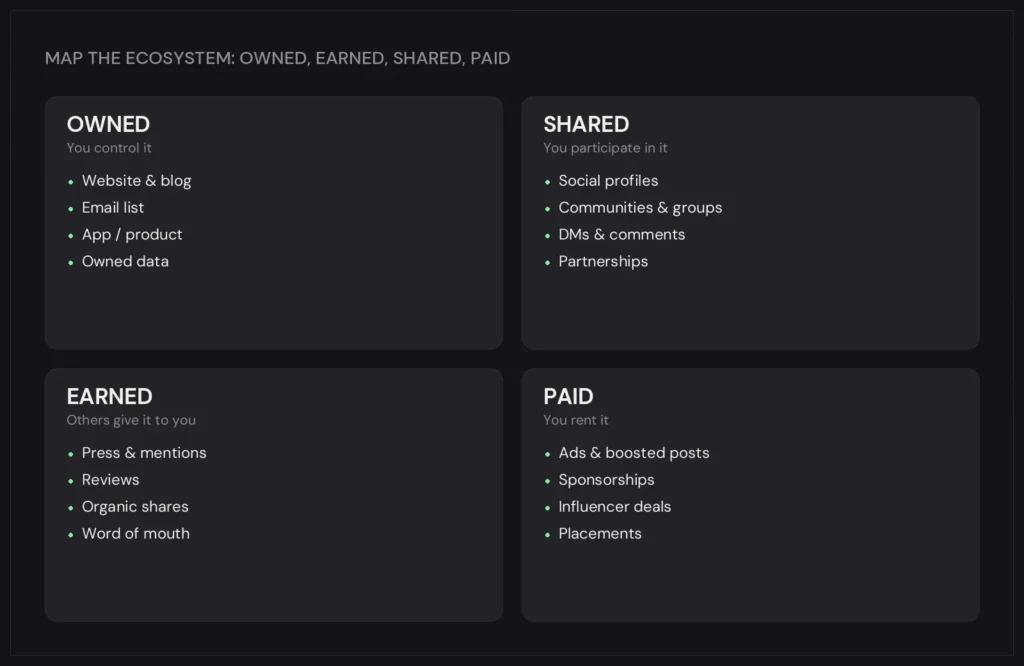
Owned media is the only media you fully control: your website, your blog, your email list, your product. Shared media is where you meet people and take part: social profiles, communities, DMs, partnerships. Earned media is what others choose to give you: press, reviews, organic shares, word of mouth. Paid media is space you rent: ads, boosted posts, sponsorships, placements.
The common mistake is building the whole presence on rented land. Platforms change their rules, throttle reach, or disappear. If everything you have lives on someone else's platform, you do not have an asset, you have a tenancy. Anchor the ecosystem in something you own, and let the rest point to it.
The website is the hub. Everything else is a spoke.
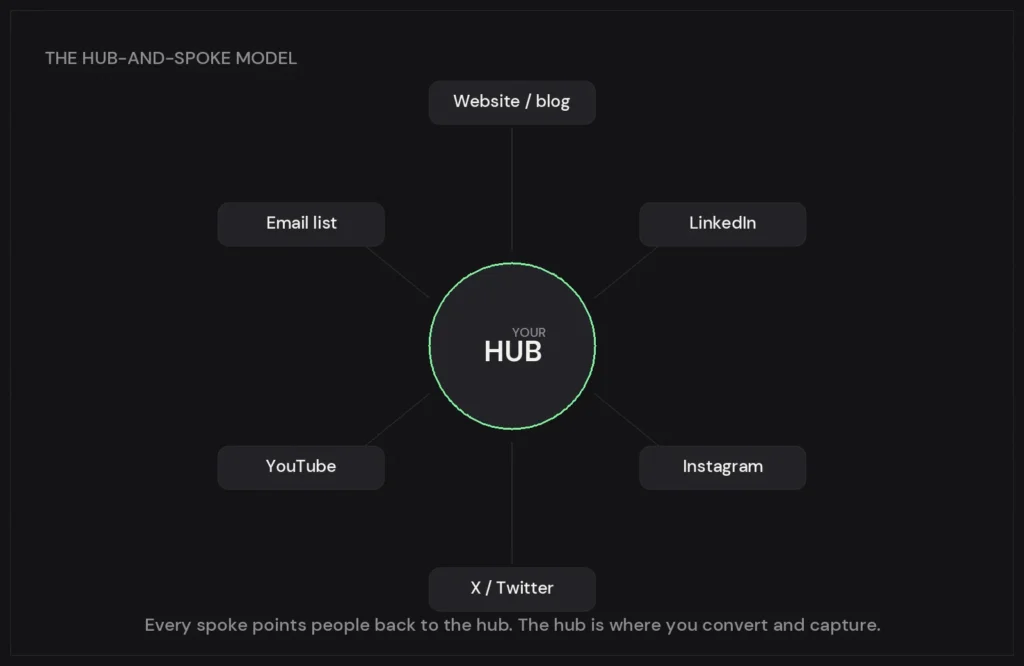
Picture the ecosystem as a wheel. The website, and the email list it captures, is the hub: the one place you own outright, where you can convert a visitor and remember them the next time they come back. The social platforms are spokes: high reach, low control, borrowed audiences that you rent access to.
Every spoke needs a job and a path back to the hub. A LinkedIn post that ends with no link, no next step and no reason to look you up is a missed connection. The hub is also where consistency is easiest to enforce, because you control every pixel, and where growth is easiest to measure, because the tracking lives there.
Give each platform a job
The same core message travels to every channel, but the format and the job change with the platform. LinkedIn tends to carry credibility and professional reach. Instagram carries visual proof and personality. X carries timing and point of view. Long video carries depth and discovery. Email carries the one relationship you actually own.
You do not need to be on all of them. Pick the two or three where your audience actually spends time, and run those properly, rather than maintaining a thin, half-abandoned presence on six.
One message architecture, many formats
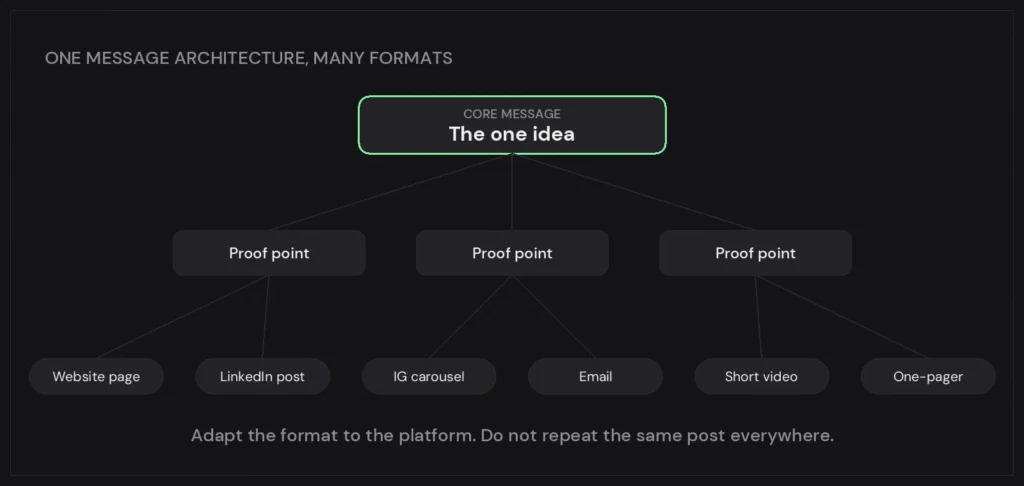
Decide the one thing you want a person to remember. Then the two or three proof points that make it credible. Then, and only then, adapt that into formats: a website page, a LinkedIn post, a carousel, an email, a short video, a one-pager. Each is shaped for its platform.
What you must not do is copy and paste the same post to every channel. It reads as automated, it ignores how each platform actually works, and it consistently performs worse. Message architecture is the thing that lets five channels say the same thing without sounding like five robots reading from the same card.
The consistency stack: what has to stay the same
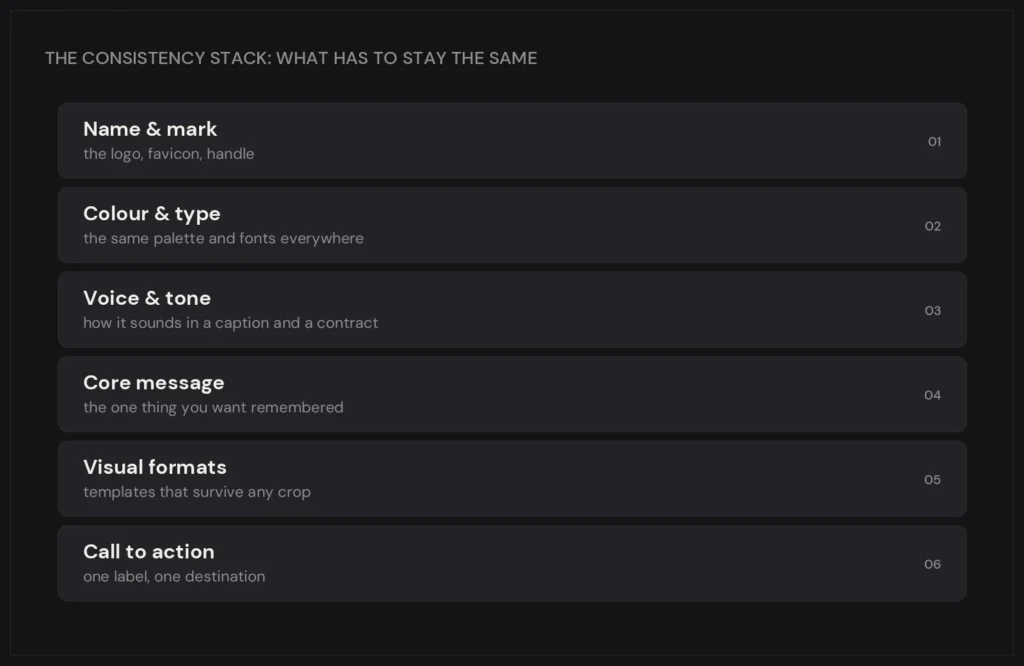
Consistency is not sameness for its own sake. It is a specific set of things that have to hold steady so the brand is recognisable wherever someone meets it: the name and mark, the colour and type, the voice and tone, the core message, the visual templates, and the call to action.
The test I use: if someone screenshots one post with the logo cropped out of frame, would they still know it is you? If the answer is no, the stack is too thin. Once a quarter, put every channel side by side, on one screen, and look for drift. It always creeps in.
Connect the ecosystem: the plumbing
Consistency makes the ecosystem recognisable. The plumbing is what makes it grow. This is the part most brands skip, and it is the reason they cannot tell which channel is actually working.
The essentials: a link hub or link-in-bio that points to the site, UTM tags on every outbound link so analytics can attribute the visit, a tracking pixel on the site so you can retarget people who did not convert, an email capture on the hub, consistent calls to action, and cross-links between your own pieces of content. Without the plumbing, traffic leaks away instead of compounding, and every report is a guess.
Growth comes from the loop, not the post
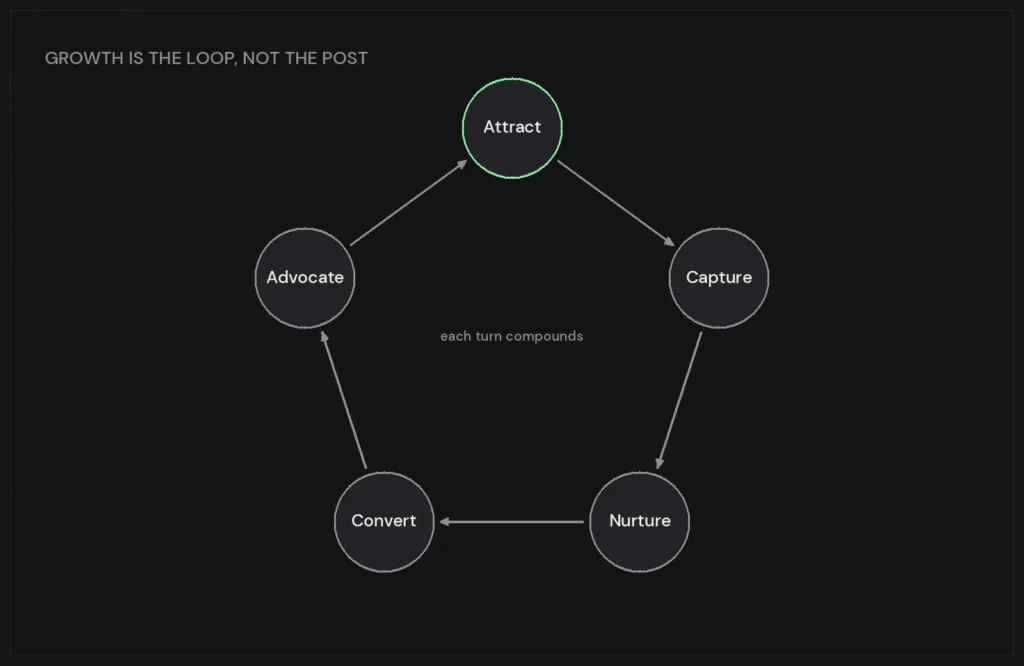
Attract people through the spokes. Capture them on the hub, with an email sign-up, a follow, a pixel. Nurture them with email, retargeting and more useful content. Convert them into an enquiry, a sale or a hire. Then turn them into advocates who share, refer and review, which feeds attraction again, only warmer this time.
A single viral post is a spike. A working loop is a slope. The job is not to chase the next spike; it is to make each turn of the loop a little more efficient than the last. That is what compounding looks like in practice.
Measure both: consistency and growth
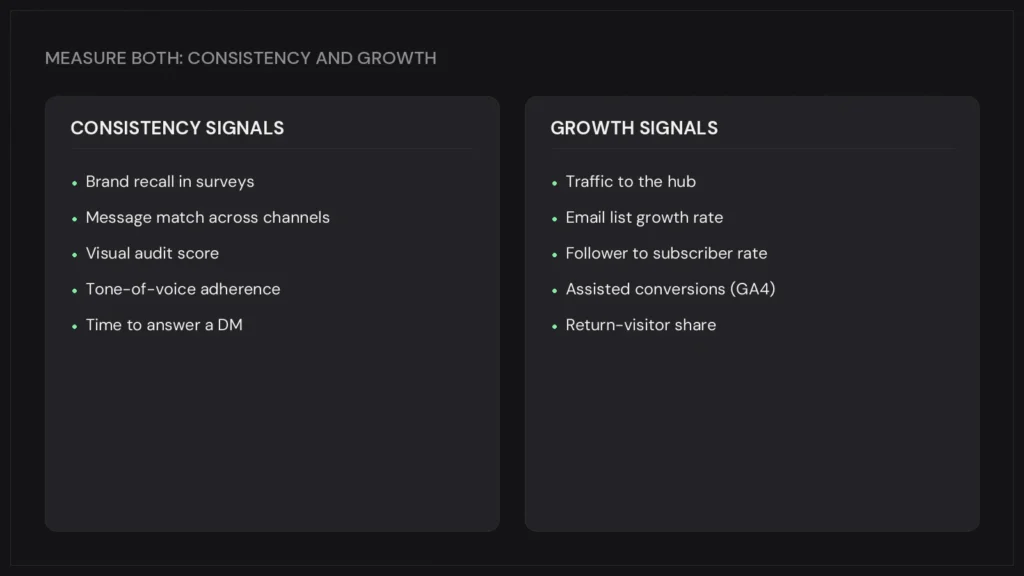
Track two sets of numbers. Consistency signals: brand recall in a quick survey, how well the message matches across channels, a visual audit score, tone-of-voice adherence, and how fast you answer a DM. Growth signals: traffic to the hub, email list growth rate, the rate at which followers become subscribers, assisted conversions in GA4, and the share of visitors who are returning.
One dashboard, reviewed monthly. If growth is flat, the problem is usually in the loop, a broken step where people fall out. If the brand feels fuzzy, the problem is in the stack. Knowing which one to look at saves weeks.
Where ecosystems break
The failure modes repeat. Building everything on rented land with no owned hub. Leaving every channel as a dead end with no path back. Letting the voice drift because different people run different platforms and there is no shared message document. Chasing every new platform instead of deepening the two that work. And measuring vanity, followers and impressions, instead of the loop, traffic, capture and conversion.
A digital ecosystem is not a bigger content calendar. It is fewer, better-connected pieces, each carrying the same story, each feeding the same engine. I have built and rebuilt versions of this across the brands I have worked with, and the pattern holds: get the map and the plumbing right, and consistency and growth stop pulling against each other.